

To Defer or Not to Defer?
This is originally an article I wrote for the monthly newsletter that I thought worth expanding into a blog post. First, what is the question we’re asking? The question is whether or how much to utilize tax-deferred retirement accounts. The distinction between all the various account types you see (IRA, Roth, SEP, 401k, TOD, etc.) is largely one of tax treatment. Tax-deferred accounts, like traditional IRAs and 401ks, have the potential advantage of lowering your taxable income in the years the contributions are made. I emphasize potential, because as the name implies, someday that tax bill will come due. As ever, there are numerous variables embedded into “someday” that determine if that deferral was truly an advantage.
However, the assumption at the core for tax-deferral is that you will be taking withdrawals at a lower effective tax rate in retirement than the marginal rate you're putting the money in during higher income years. For example, your marginal dollar might be taxed during your peak earning years at 24% or even higher. However, in retirement that money might be getting pulled out at an effective rate of say 14%. In this case, the deferral was clearly advantageous.
Like many areas, I would characterize my thoughts as outside of the mainstream consensus here. That consensus, I believe, mistakes the question for one of pure optimization and math. Let’s make some reasonable assumptions of what “someday” looks like relative to today, and those numbers will guide our hand.
What are we reasonably assuming though, what gets lost in the equation, and what are the tradeoffs we sign off on when utilizing a tax deferred account? That’s the question I want to explore. My concerns, or these implicit tradeoffs to which we’re knowingly or unknowingly assenting, are twofold, and they both relate more broadly to the concept of financial repression which I will expand on below.
My first concern may be more palatable to the mainstream as at least a justification to diversify the tax treatment of your accounts, i.e. don’t put all your eggs in the tax-deferred basket. The government could be viewed as the co-owner of your tax-deferred account given the large future tax-liability the account represents. Again, the hope is that as you transition from peak earning years to retirement this will lead to some ultimate tax savings as described above. In my mind, a government $39 Trillion in debt and maintaining near-recessionary level deficits poses a real challenge to that core assumption, and rendering it no sure bet in the years ahead. The last time the government's fiscal situation was this imperiled, taxes were more than just a little higher. This could mean little to no tax advantages, or at worst, a tax disadvantage to deferral.
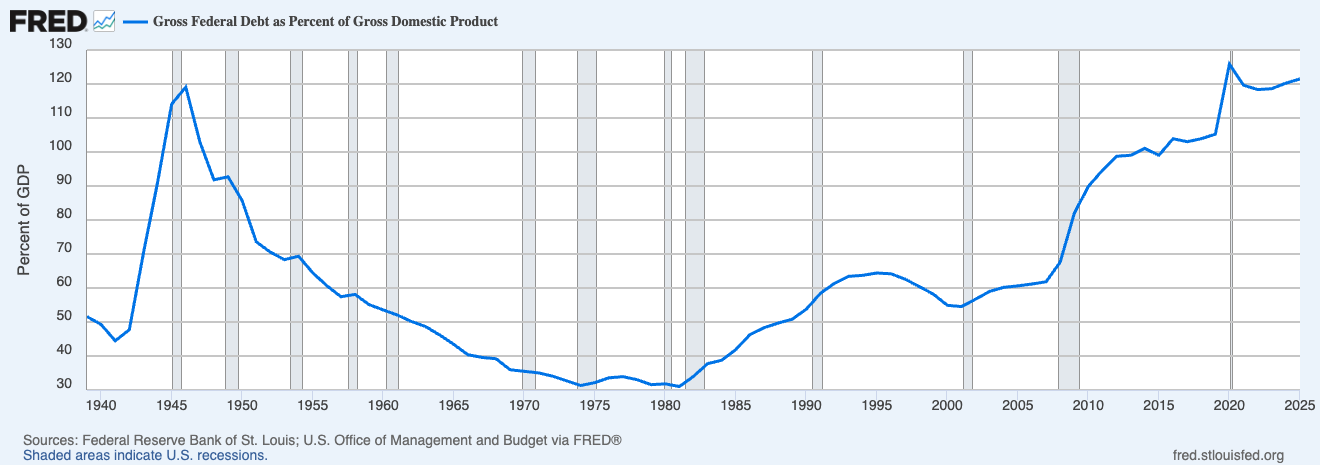
U.S. Government Debt to GDP Ratio
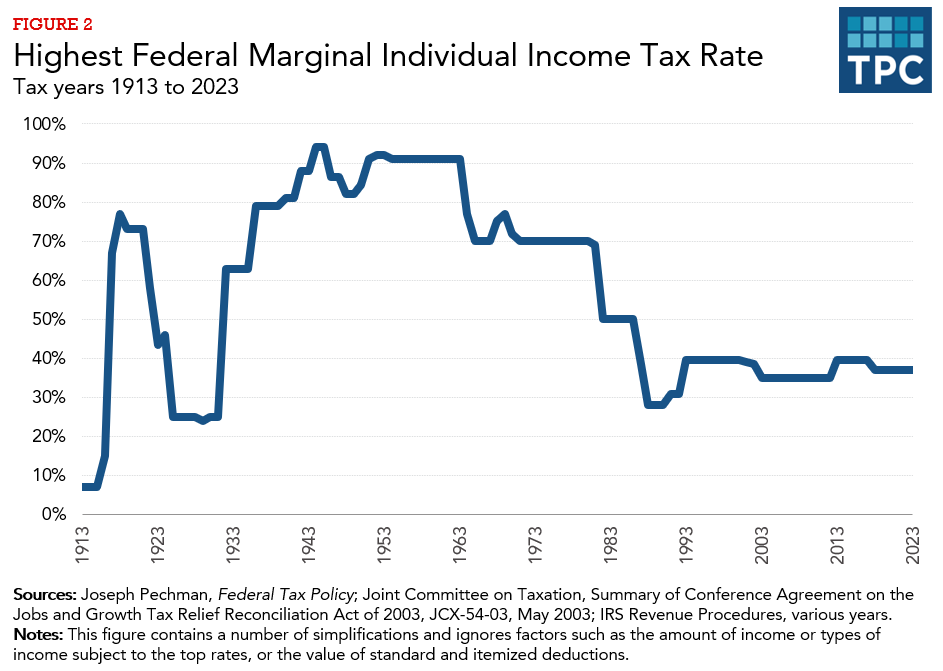
Highest Marginal Tax Rates Over Time
The second, and far less mainstream concern, centers on my concerns regarding more overt methods of financial repression needing to be used to address these sovereign debt challenges. Higher tax rates are certainly a tool but hardly the only one at the government's disposal, and given their unfavorability, taxes may play merely a supporting role.
First, a brief explainer on financial repression. In short, it’s a historical playbook that has been deployed to address prior government debt imbalances whereby the government takes a significantly more heavy handed approach to the allocation of capital throughout the economy in an effort to erode the real value of the debt burden. I emphasize real as generally not a red cent of government debt ever gets truly paid off. The effects of inflation and growth are channeled to reduce the burden of servicing that debt over time.
Here’s a simple household example to illustrate the point. You have a $200,000 fixed mortgage which costs you $2,000 per month, and you make $4,000 per month in income. Your servicing of that mortgage debt is 50% percent of your current income. Over time, your income doubles to $8,000 per month while your mortgage remains fixed. Your debt service now represents only 25% of your total income despite no change to the debt itself. It is not so much the level of debt but your ability to service it that really matters.
Unlike in the household example, the US debt continued to grow from the 1940s to the 1970s. The economy, and in turn the ability to service that debt, just grew far faster. I would highly recommend the work of Russell Napier for anyone looking to dive deeper into this topic.
Returning to the deferral question, it is important to note that you are technically not the owner of your qualified accounts. These assets are essentially held in trust with you as the beneficiary. In normal circumstances, this might be a distinction without a difference. In abnormal times, this distinction could be significant.
In the newsletter, this was a companion article to one centered around the same financial repression theme but applied to Trump Accounts where I suggested that the imposed investment restrictions, namely the ownership of only passive US investments, could be seen as a trial balloon for future regulatory actions and outright capital controls.
Capital controls restrict the free movement of money in and out of a country and are often a cornerstone policy of financial repression. If you can no longer find volunteer buyers for certain assets, you draft less willing buyers. However, it’s difficult to enlist money that’s ditching the proverbial draft by investing overseas. Enter capital controls.
While the Trump Accounts in isolation seem insignificant, these sorts of restrictions can start with a trickle and end with a flood. To be clear, there’s far from a flood yet, but there’s some notable trickles. One is the rising drumbeat of proposed and actual restrictions on Chinese investments by US citizens. A clearcut case would be the removal of mainland China and Hong Kong stocks from the international stock fund within the government TSP, the retirement plan for most government employees and military service members.
Outside our shores, there’s been similar rumblings in the UK about changes to their equivalent of an IRA, ISA accounts. This includes making the tax-deferral dependent upon accounts holding a certain percentage in UK-domiciled assets. It’s just rumblings for now, but crises tend to make fertile ground for these sorts of sweeping measures.
Obviously, much of this is speculation on my part, but I do think these concerns are grounded in the longer-term endurance we prize. Of course, individual circumstances still matter greatly in rendering any true advice on the subject, and I’m far from suggesting a one-size fits all solution for this complicated question. If anything it’s a pushback to the one-size fits all advice of maxing out qualified retirement accounts and always erring on the side of deferral.
The real answer doesn’t revolve around trying to predict future policy but instead reflecting on what fragility we invite if we focus on optimizing to the present rules of the game? As we’re fond of saying, “when the going gets tough, the government changes the rules.” While we don’t need or want to predict future policy, we don’t want to rely on the more benign paths either. This is what we mean in our philosophy that we, “prize real claims over abstractions. We remove the obstacles to real ownership.”