

Exit Liquidity
I know what I was supposed to think about The SpaceX IPO: awe at that which it already is and wonder for what it will soon become. If landing reusable rockets and satellites enmeshing the globe in digital connectedness weren't enough to tantalize your animal spirits, merging the latest trophy in Elon's commercial empire, xAI, should do the trick. In an age of thematic investing and the proliferation of ETFs to meet your every speculative itch, comes an IPO that nearly captures them all: artificial intelligence, space exploration, data centers in space, and on and on. Endless possibilities, what more could one want?
Of course, beneath it all, I was supposed to feel something deeper. The pang of being left behind. Left behind with all the rubes and luddites who couldn't but imagine the future. It's amazing how in the coming age of abundance and untold riches we're promised, we're all still so afraid to miss out.
I know what I was supposed to think, and yet, the inescapable thought rolling around my head over and over again was exit liquidity. Exit liquidity, that’s the polite way of saying, foisting dubiously valued securities from insiders and early investors onto the broader investing public in order to realize the former’s profits. Similar to the old card-playing adage, if you don’t know who the exit liquidity is, you just might be it.
SpaceX seemed yet another of the mounting examples of exit liquidity in the golden age of grift: SPACs, retail-friendly private equity and credit vehicles, crypto ETFs to name a few. All of these are consistently wrapped in language like "access" or "democratization." This is Wall Street, not the Red Cross. If you're searching for benevolence, you've come to the wrong place. Another Saecula Wealth favorite writer and thinker, Ben Hunt, has a mantra to repeat before engaging in modern media, "Why am I reading this now?" I'll propose a corollary, "Why am I being sold this now?"
Access to Bitcoin or crypto broadly wasn't a priority when the narrative was disintermediating the banks and upending the financial system. Bitcoin was the coin of the nether realm: hackers, drug dealers, and other malcontents. Now, access to the increasingly neutered and placid version of Bitcoin and crypto, that suits them. Private equity purveyors had no problem with your lack of access when the high returns rolled in like clockwork. Isn't it odd that the hardships of private equity and its debt-enabling cousin, private credit, are running rampant in the headlines coincident with access coming to everyone in a 401(k) plan near you? Access suits them now. Access provides exit liquidity.
Raising public money now suits SpaceX, and the list of other epic IPOs on tap in the months ahead, and if enough imaginative and visionary buyers can't be found, the aggressive, early enlistment of the "voting machine's" assistance can fill the gap.
Chuck Prince, the former CEO of Citigroup, once commented “When the music stops, in terms of liquidity, things will be complicated. But as long as the music is playing, you've got to get up and dance. We're still dancing.” These words were immortalized as they were uttered in July 2007 when we were already in the early throes of what would become the Great Financial Crisis where Citi, along with its big bank brethren, began its own near death march to $0.97 a share.
Is the music skipping a few beats then as now in this trillion dollar game of musical chairs? I think we all feel, deep down, the music will stop. We just need to find the right ticket out of here before it stops, our veritable rocket to Mars. A last chance to climb the ladder before it forever gets pulled up behind us. Wall Street is all too happy to provide those tickets. As always, an expansion of that willingness runs headlong into that stubborn law of supply and demand. Will the raft of upsized IPOs capsize the whole stock market boat?
Or is this
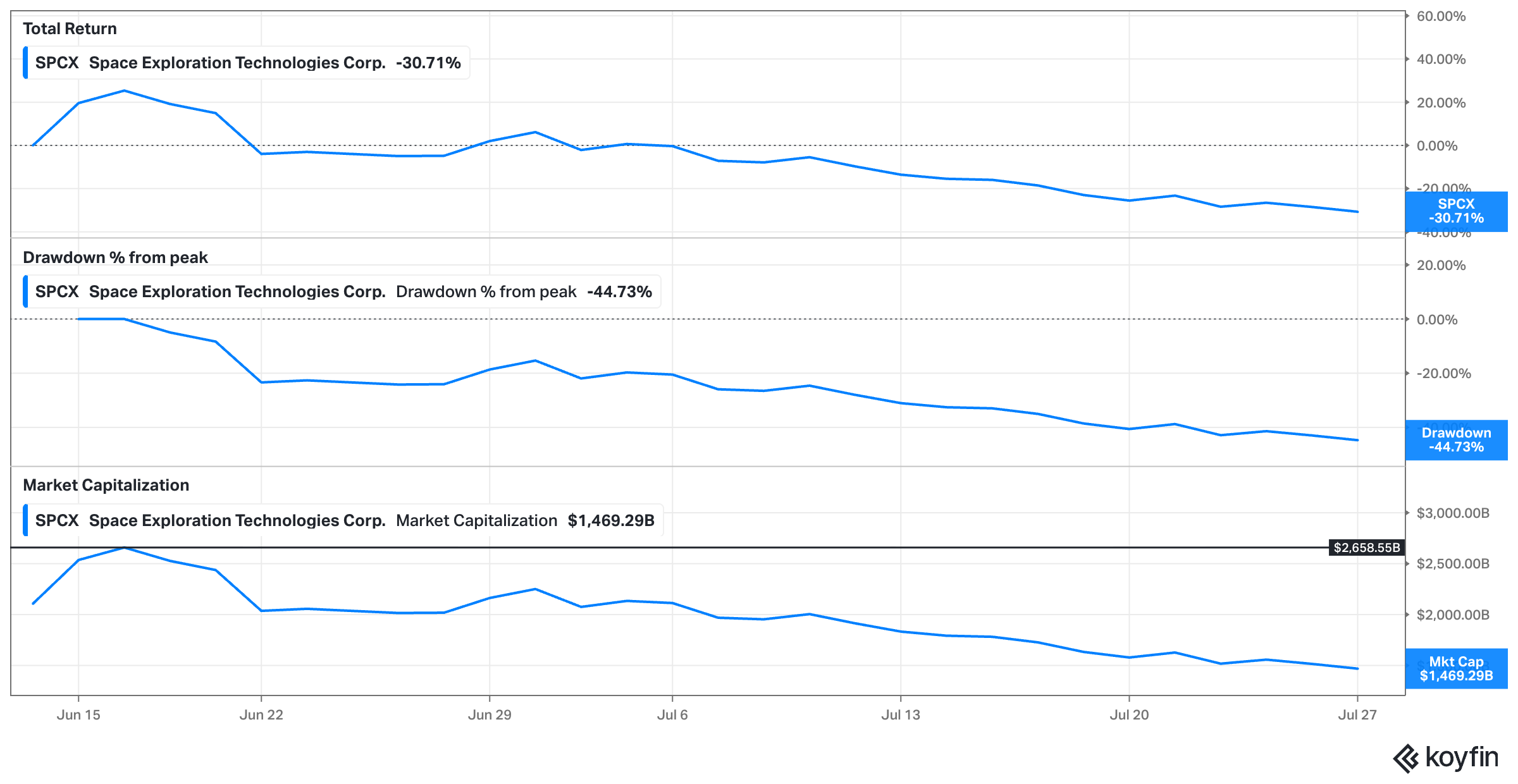
SpaceX Post-IPO Performance
merely the lull before liftoff? The last stop before the riches that await those bold enough to board the rocket ship. I rest easy knowing my wealth doesn't rely on needing to know or even needing to play that game.